


Google Just Gave Organic Creator Content a Measurable Second Life


For years the case against creator campaigns was the same. Great for awareness, hard to prove once the feed moved on. A strong post landed, spiked, and slipped back into the scroll. You could see it working in the moment. Showing it kept working, weeks later, was the harder part. That line just moved the latest updated to the Google Search Console.
On 7 July 2026, Google introduced ‘platform properties’, a new property type in Google Search Console. It lets creators and publishers see how their Instagram, TikTok, X and YouTube content performs in Google Search and Discover: clicks, impressions, top posts and the queries sending people there, across its Performance, Insights and Achievements reports. Google outlined the update in Search Central, with setup detail in the help centre. It is rolling out gradually over the coming weeks.
Until now, Search Console required a verified website. For the first time, creators with no website at all can connect a social account and see how their content surfaces in Google Search.
What it actually answers
This is not another dashboard promising to solve creator ROI overnight. It answers a narrower, more useful question: what happens to a post after it stops being new?
Worth being exact, because the detail changes how it is used. It is organic Search Console reporting, so it shows how content surfaces in Google, not how it performs in-platform. It will not show TikTok in-app views, only the traffic Google sent. It is not the same as Search profiles, the public creator pages Google launched in June 2026: one exposes content, the other measures it. And it builds on a December 2025 experiment that first pulled social channel data into Search Console.
One honest limit. This closes a measurement gap. It does not solve attribution. It shows durable visibility, not the sale. Anyone reading a Search Console update as proof of social ROI is asking too much of it.
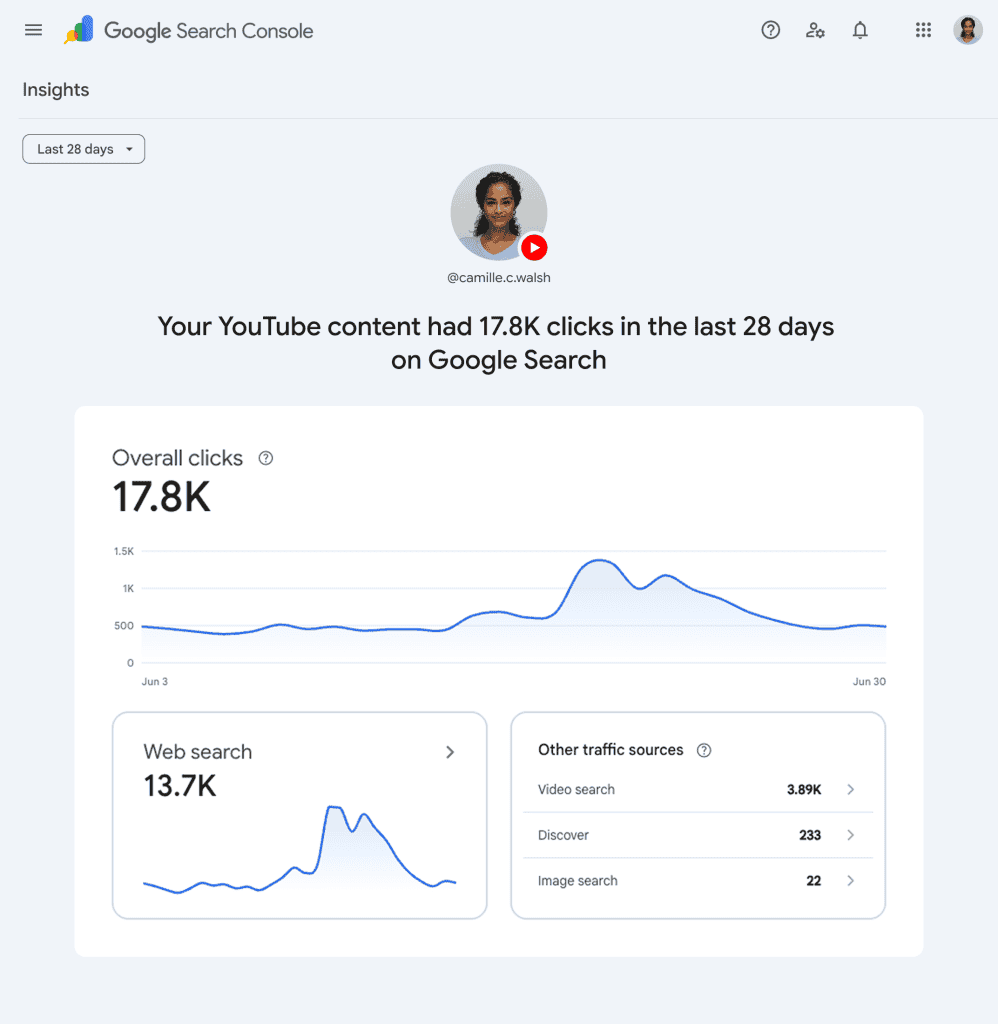
A post can now have a second life
Here is the shift worth paying attention to. Organic creator content is no longer only an in-feed moment. It can keep surfacing for real searches long after the campaign window closes, and now that afterlife is measurable.
Brands have always paid for in-platform reach. What they rarely saw was the tail: the searches a post answered weeks later, quietly, after everyone stopped looking. Platform properties make that visible. Not every post will earn it. But when a post does keep working, there is finally a number attached.
This is the rented-versus-owned influence question in a different frame. The influence you rent disappears the moment the budget stops. The influence you own keeps working after the feed moves on, and now a slice of that afterlife has a number attached to it. It is a small window onto a bigger idea: how much of your influence would still be there if you stopped paying for it?
The timing is not an accident. 47% of Google searches now trigger AI Overviews, with only around 1% resulting in a click. Attention is spreading across AI answers, social, video and classic results at once. A brand measuring only its website is measuring a shrinking slice of where it is actually found.
The next creator brief
If a post can have a second life, it should be briefed for one.
That sharpens the creative brief rather than replacing it. The cultural pull still has to be there, or nothing gets found in the first place. But a post built to answer a real question, aimed at real intent, with an audience that’s genuinely looking for it, has somewhere to go once the feed moves on. A post built only to interrupt the scroll doesn’t apply here. The work worth doing is the one that does both: earns attention this week, and answers searches for months.
There is also a nuance clients need to hear early, not late. Platform properties track the creator's property, not the brand's. Whoever verifies the property owns the data. If a creator owns the property, the creator owns the search numbers. That single point changes how a campaign should be structured and contracted, and it belongs in the conversation before anyone signs, not after the results come in.
Better built together
The shift also changes how creative and search teams need to work together. It rewards planning creator content for search from the very first brief, and that is a two-sided job.
It is the thinking behind Disrupt and its sister agency Found. Disrupt builds the creator content. Found makes it findable. Disrupt runs the creator-first, culturally relevant campaigns that land for the likes of Wizz Air, Vinted and The FA. Found owns the search and amplification layer, making sure that content earns visibility and is measured across every surface through its Everysearch™ approach. One side makes people care. The other makes sure the content they care about can be found.
For a client, the benefit is straightforward: creator campaigns designed for search from day one, and one team answering the ownership question before it becomes a problem. Disrupt briefs the creative for cultural pull and platform nativeness. Found builds in the search intent, the AEO, GEO and entity signals so the content ranks and gets measured. Two returns from one investment. The Found companion to this piece picks up the search and measurement side of the same story.
The question brands need to answer
Google has given creator content a measurable second life. The next brief decides what to do with it. Is the content being built to win the feed this week, or to answer the searches that come after?
The best creator work can now do both: win the feed this week, and answer the searches that come after. That durability is what genuine influence looks like in practice. The only real question is whether it is briefed to."
Planning a creator and influencer marketing campaign that needs to last longer than the feed? Talk to Disrupt.

 7 MIN READ
 9 MIN READ
 7 MIN READ